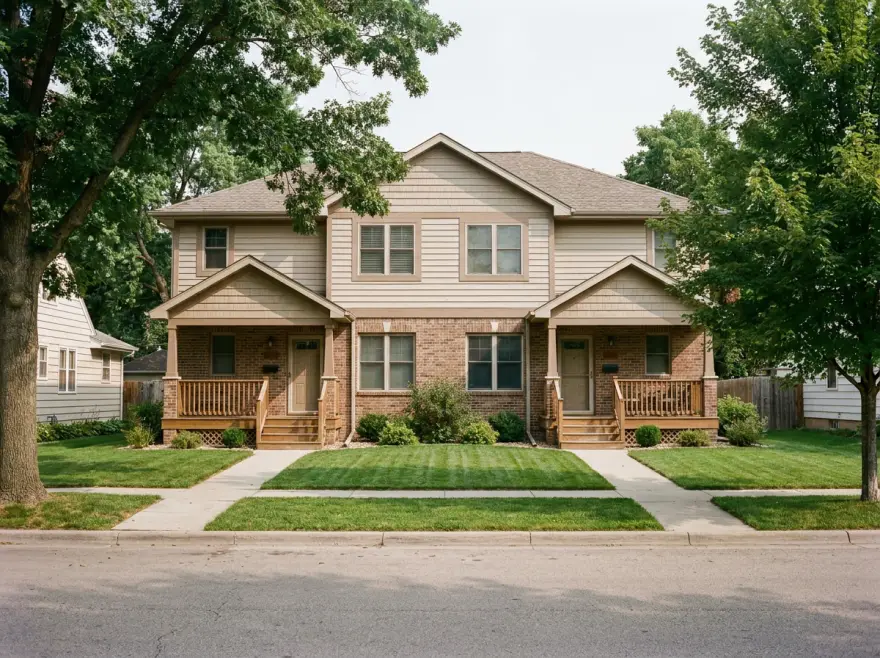
Duplex Insurance Coverage Options
Duplex and two-family property insurance covers the full structure, your rental income, and your liability — whether you live in one unit or rent both. A standard homeowners policy isn't built for this exposure; we'll match you with the right policy type for your situation.
What Your Duplex Insurance Covers
A duplex policy is built to protect the full structure, your rental income, and your liability as a property owner — whether you live there or not.
Dwelling Coverage
Protects both units of your duplex structure — walls, roof, foundation, built-in systems — against covered perils like fire, wind, hail, and lightning.
Liability Protection
Covers injuries to tenants, guests, or visitors on the property. Pays for medical expenses, legal fees, and settlements if you're found responsible.
Loss of Rental Income
Covers lost rent from the rented unit if it becomes uninhabitable after a covered loss. Keeps your income stream protected while repairs are underway.
Other Structures
Covers detached garages, sheds, fences, and other structures on the duplex property that aren't attached to the main building.
Owner-Occupied vs. Investment Duplex
How you use your duplex determines what kind of policy you need. Getting this wrong can leave you with a denied claim.
Owner-Occupied Duplex
You live in one unit and rent the other. This is the most common duplex scenario — and the most misunderstood from an insurance standpoint.
- May qualify for a homeowners policy with a landlord endorsement
- Hybrid policies cover your personal property AND the rental unit
- Additional living expenses covered if you're displaced
- Liability covers both your unit and the rental unit
- Often more affordable than a full investment property policy
Full Investment Duplex
Both units are rented — you don't live on the property. This is a purely investment property and requires a landlord or commercial-style policy.
- Requires a dwelling fire (DP-3) or landlord policy
- No personal property coverage for the owner
- Loss of rents covers income from both units
- Liability limits should reflect both tenants' exposure
- Vacancy clauses can limit coverage if a unit sits empty past the period your policy sets
Why a Standard Homeowners Policy Is NOT Enough for a Duplex
A standard HO-3 homeowners policy is designed for an owner-occupied, single-family home. The moment you rent out any portion of your duplex, you've changed the risk profile in ways that can void your coverage or result in a denied claim.
Landlord Liability Gap
Standard homeowners policies often exclude landlord-tenant liability. A tenant injury on your property could be uncovered.
No Loss of Rents
If your rental unit is damaged and uninhabitable, a standard homeowners policy won't reimburse you for the lost rental income.
Material Misrepresentation
If you have an HO-3 and your insurer discovers you're renting a unit, they can deny your claim or cancel your policy entirely.
What Affects Your Duplex Insurance Rate
Carriers weigh several factors when pricing duplex coverage. Here's what matters most — and where you have room to lower your premium.
Owner-Occupied vs. Full Investment
Living in one unit can qualify you for more favorable rates and policy types. Full investment duplexes require landlord or commercial policies with different pricing.
Age and Construction of the Building
Older duplexes with outdated wiring, plumbing, or roofing cost more to insure. Brick construction typically earns lower rates than wood-frame buildings.
Number of Claims on Property
Prior claims on the property — even from previous owners — can increase your premium. Multiple claims in a short window can trigger surcharges or non-renewal.
Rental Income Amount
Higher rental income means more loss of rents exposure. Carriers factor in the rental income when calculating loss of rents and liability limits.
Location and Neighborhood Risk
Crime rates, proximity to fire stations, and local weather exposure all factor into your rate. Springfield neighborhoods vary significantly in these risk factors.
Condition of Roof, Plumbing, Electrical
Updated systems tend to rate better. An older roof, knob-and-tube wiring, or galvanized pipes can trigger surcharges or coverage restrictions.
Whether Tenants Have Renters Insurance
Requiring tenants to carry renters insurance can reduce your liability exposure. Some carriers view this favorably when calculating your premium.
Duplex Insurance for Springfield, IL Multi-Family Properties
Many of Springfield's duplexes are in established, older neighborhoods.
For owner-occupants, a Springfield duplex offers the ability to offset mortgage costs with rental income from the second unit, with renters drawn by employers such as state government, HSHS St. John's Hospital, Memorial Medical Center and UIS. For investors, a duplex is a smaller step into multi-family property.
Older duplexes get extra attention from carriers, which look at roof age, wiring type (knob-and-tube wiring is a red flag), plumbing material, and overall condition. Updated systems tend to rate better and qualify for broader coverage. Central Illinois gets hailstorms, ice storms and occasional tornadoes, and one storm can damage both units at once. One storm can mean two repair jobs and two displaced households, so adequate dwelling and loss-of-rent limits are critical.
If you live in one unit and rent the other, you need either a homeowners policy with a landlord endorsement or a hybrid owner-occupied landlord policy — standard HO-3 coverage typically excludes or limits landlord liability. Getting this wrong can mean a denied claim when it matters most. We'll compare your options and find the structure that covers everything without duplication.
Duplex Insurance FAQ
Answers to the questions Springfield duplex owners ask us most.
Not always. A standard homeowners policy (HO-3) is designed for a single-family, owner-occupied residence. If you rent out any portion of your duplex — even just one unit — you've introduced a landlord exposure that most homeowners policies don't cover or will exclude. You may need a hybrid owner-occupied policy with a landlord endorsement, or a separate landlord/dwelling fire policy. We'll make sure you have the right policy for your specific situation.
Landlord insurance (also called a dwelling fire policy or DP-3) is designed for non-owner-occupied rental properties. Duplex insurance can refer to either a landlord policy or a hybrid homeowners policy depending on whether you live in one of the units. The key differences are coverage for your personal property, liability structure, and loss of rents provisions. Owner-occupied duplexes typically get broader personal property coverage than pure investment properties.
This is the most common duplex scenario — and the most important to get right. You may qualify for a homeowners policy with a landlord endorsement, or you may need a separate dwelling fire policy for the rental unit alongside a standard homeowners policy for your unit. Some carriers offer a single hybrid policy covering both units under one premium. We'll compare your options and find the most cost-effective coverage that doesn't leave gaps.
Yes — the dwelling coverage in a duplex policy protects the entire structure, which includes both units. However, the policy type and what's covered inside each unit varies. Your personal property (if you live in one unit) is covered under your homeowners-style coverage. Your tenant's personal belongings are NOT covered — they need their own renters insurance policy. Liability coverage protects you as the property owner, not the tenant.
Duplex insurance in Springfield, IL depends on the property's value, age, condition, whether it's owner-occupied or fully rented, and the coverage limits you choose. Owner-occupied duplexes often qualify for different (and sometimes lower-cost) policy forms than fully rented investment properties. The best way to know your exact cost is to get a free comparison quote — we'll shop 30+ carriers so you can compare.
If your tenant intentionally causes damage, most landlord and duplex policies cover tenant-caused damage under your dwelling coverage (subject to your deductible). However, you would need to pursue the tenant for reimbursement. Accidental tenant damage — like a bathtub overflow or kitchen fire — is typically covered. This is also why requiring renters insurance for your tenants is smart: their liability coverage can pay you back for damage they cause.
No — in most cases, a single duplex or dwelling fire policy covers the entire structure and both units under one policy. You don't need two separate policies. However, if you live in one unit, you may want a combined policy that includes homeowners-style coverage for your personal belongings and ALE (additional living expenses) in addition to the landlord coverage for the rental unit.
Yes, in many cases you can bundle your duplex insurance with your auto policy through the same carrier and qualify for a multi-policy discount. However, not all carriers offer bundle discounts on landlord/investment properties the way they do on owner-occupied homeowners policies. We'll check bundling options when we shop your duplex insurance so you can compare the total cost across all your policies.
Have a question we didn't answer?
Serving Springfield and Surrounding Areas
From historic Springfield neighborhoods to the surrounding communities of Sangamon County, we've got you covered.
Free · No obligation · Under 5 minutes
Get the Right Duplex Coverage Today
Don't risk a denied claim with the wrong policy. Get a free duplex insurance quote and we'll make sure you're properly covered.
One call, 30+ carriers
You see the whole market, not one company's price.
A local agent, not a call center
The same person answers when you need to claim.
30 years in Central Illinois
We know which carriers actually pay out here.